
Data Darbar
 Data Darbar located in the city of Lahore, Punjab, Pakistan is the largest Sufi shrine in South Asia. It was built to house the remains of the Muslim mystic, Abul Hassan Ali Hujwiri, commonly known as Data Ganj Baksh, who is believed to have lived on the site in the 11th century CE. The site is considered to be the most sacred place in Lahore,and attracts up to one million visitors to its annual urs festival
Lahore Fort
 The Lahore Fort is a citadel in the city of Lahore,Punjab. The fortress spreads over an area of more than 20 hectares with twenty one monuments, some of which date to the era of Emperor Akbar. The Lahore Fort was almost entirely rebuilt in the 17th century,at the height of splendour and opulence of the Mughal Empire. The first record of a fortified structure at the present site of Lahore Fort can be traced back to an 11th-century built mud-brick fort.The foundations of the modern Lahore Fort date's back to the reign of Emperor Akba in 1566. As was characteristic of Emperor Akbar, the fort had a syncretic architectural style featuring both Islamic and Hindu motifs. Subsequently,all emperors added to the beauty of the fort with their own inclinations. During Shah Jahan's period, the fort was inlaid with luxurious marble in Persian floral designs, while the iconic Alamgiri Gate was constructed by the last of the great Mughal Emperors, Aurangzeb.The fall of Mughal Empire saw the usage of Lahore Fort as residence of Ranjit Singh, founder of the Sikh Empire. The battle of Gujrat,1849 saw the annexation of Punjab by the British and the fort also moved to the custody of the British colonialists. in 1981, Lahore fort was inscribed as a UNESCO World Heritage Site for its "outstanding repertoire" of Mughal monuments.
Tomb of Allama Iqbal
 The Tomb of Allama Muhammad Iqbal, or Mazaar-e-Iqbal is a mausoleum located in Hazuri Bagh,Lahore. Allama Muhammad Iqbal, also known as Muffakir-e-Pakistan (The Thinker of Pakistan) or Shair-e-Mashriq (The Poet of the East), died on 21 April 1938 in Lahore at the age of 60. He was not only the national poet of Pakistan but was also one of the major inspirations behind Pakistan Movement.
Legend has it that Mustafa Kemal Atatürk sent earth collected from Maulana Rumi's tomb to be sprinkled on this grave. Today, thousands of visitors come to the mausoleum every day to pay their respects to the poet-philosopher.
Walled City
 The Walled City of Lahore , also known as Old City, forms the historic core of Lahore. Lahore city was established around 1000 CE in the western half of the Walled City, which was fortified by a mud wall during the medieval era. The Walled City rose in prominence after being selected as the Mughal capital, which resulted in construction of the Lahore Fort - now a UNESCO World Heritage Site. The Walled City was bestowed with numerous monuments during the Mughal era, such as Wazir Khan Mosque, Badshahi Mosque, Shahi Hammam, etc. Under Sikh rule, Lahore was again nominated the capital, thus further increaisng its prominence through the construction of Samadhi of Ranjit Singh and the Gurdwara Janam Asthan Guru Ram Das.The Walled City today remains the cultural heart of Lahore, and is home to many of its tourist attractions. In 2012, the Pilot Urban Conservation and Infrastructure Improvement Project—the Shahi Guzargah Project was launched in order to restores a section of Shahi Guzargah ("Royal Passage") between the Wazir Khan Mosque and Delhi Gate under the management of the Walled City of Lahore Authority. The first phase of the project was completed in 2015 with support from the governments of Norway and the United States of America.
Iqbal Park
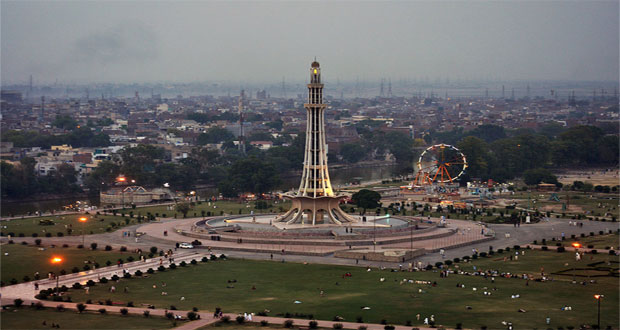 Iqbal Park formerly known as Minto Park, Lahore is an urban park renamed as Greater Iqbal Park after its renovation and expansion. The project for renovation started in October, 2015 and was completed in November , 2016 incurring a total cost of PKR 981 million. The construction project was awarded to Habib Construction Services which is one of the largest construction companies of Pakistan and have worked on several other mega projects previously.
Noted as the home of Minar-e-Pakistan, the 125-acre park includes an artificial lake which spreads over four acres and houses an 800-feet-long musical fountain. Other attractions includes a soft rail, library, an open-air gym and a food court. The tombs of Allama Iqbal and Hafeez Jalandhari are also located in the park.
This125 acre green oasis is surrounded almost entirely by the old city of Lahore. Visitors can lounge on rolling lawns and take in the panoramic view of the symbolic Minar-e-Pakistan, the majestic Lahore Fort, the iconic Azadi Interchange and the historic Badshahi Mosque that also shelters the tomb of Allama Iqbal (1877-1938). For those who prefer a more active itinerary, 4 kilometer long walkways provide ample opportunities for running and cycling. In addition the guests can take a stroll through the cascade surrounded by four memorial monuments, ride in the soft rail that runs along the 2 kilometer long Buggy Track or picnic near the lake and enjoy 800 feet long musical fountain performance. Moreover, the park features lush greenery, ample seating and artistic food courts and shopping kiosks for visitors. A history museum and an outdoor amphitheater are under construction inside the park premises.
Food Street
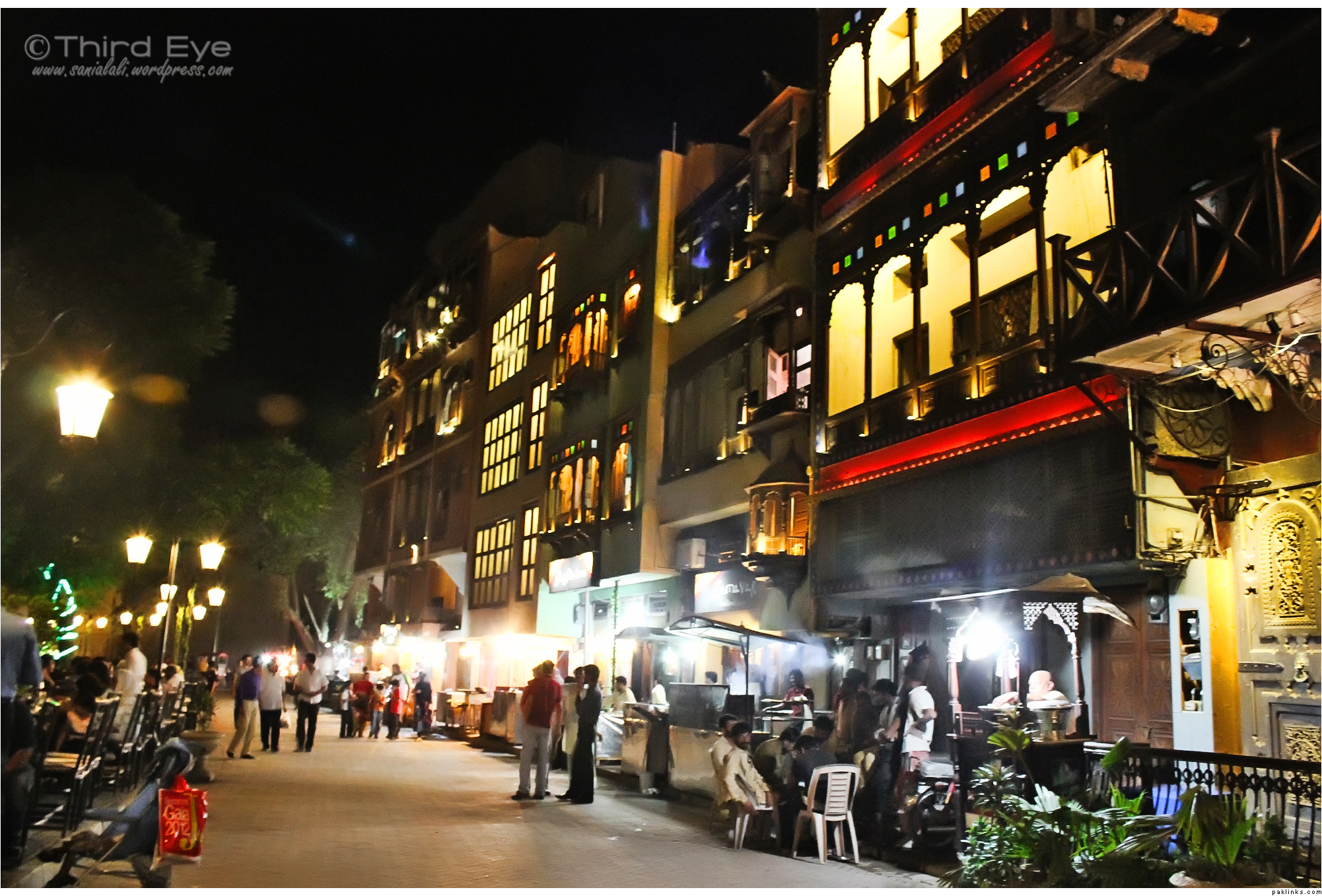 Food Street located between Fort Road and Roshnai Gate of the Walled City in Lahore. The street was reconstructed and opened as a tourist attraction, by offering Lahori cuisine and views of Badshahi Mosque the Street was inaugurated on 21 January 2012, by Hamza Shahbaz Sharif.
Shalimar Garden
 The Shalimar Garden sometimes spelt Shalamar Gardens, is a Mughal garden complex located in Lahore, capital of the Pakistani province of Punjab. The gardens date from the period when the Mughal Empire was at its artistic and aesthetic zenith,and are now one of Pakistan's most popular tourist destinations.
The Shalimar Gardens were laid out as a Persian paradise garden intended to create a representation of an earthly utopia in which humans co-exist in perfect harmony with all elements of nature.Construction of the gardens began in 1641 during the reign of Emperor Shah Jahan, and was completed in 1642. In 1981 the Shalimar Gardens were inscribed as a UNESCO World Heritage Site as they embody Mughal garden design at the apogee of its development
Badshahi Masjid
 The Badshahi Masjid is a Mughal era masjid in Lahore, capital of the Pakistani province of Punjab, Pakistan. The mosque is located west of Lahore Fort along the outskirts of the Walled City of Lahore, and is widely considered to be one of Lahore's most iconic landmarks.
Badshahi Mosque was commissioned by Emperor Aurangzeb in 1671, with construction of the mosque lasting for two years until 1673. The mosque is an important example of Mughal architecture, with an exterior that is decorated with carved red sandstone with marble inlay. It remains the largest and most recent of the grand imperial mosques of the Mughal-era, and is the second-largest mosque in Pakistan. After the fall of the Mughal Empire, the mosque was used as a garrison by the Sikh Empire and the British Empire, and is now one of Pakistan's most iconic sights.
Wazir Khan Masjid
 The Wazir Khan Masjid is 17th century mosque located in the city of Lahore, capital of the Pakistani province of Punjab. The mosque was commissioned during the reign of the Mughal Emperor Shah Jahan as part of an ensemble of buildings that also included the nearby Shahi Hammam baths. Construction of Wazir Khan Mosque began in 1634 C.E., and was completed in 1641.
Considered to be the most ornately decorated Mughal-era mosque, Wazir Khan Mosque is renowned for its intricate faience tile work known as kashi-kari, as well as its interior surfaces that are almost entirely embellished with elaborate Mughal-era frescoes. The mosque has been under extensive restoration since 2009 under the direction of the Aga Khan Trust for Culture and the Government of Punjab,with contributions from the governments of Germany, Norway, and the United States.
Jahangir Tomb
 The Tomb of Jahangir is a 17th century mausoleum built for the Mughal Emperor Jahangir. The mausoleum dates from 1637, and is located in Shahdara Bagh in Lahore, Punjab, Pakistan, along the banks of the Ravi River.The site is famous for its interiors that are extensively embellished with frescoes and marble, and its exterior that is richly decorated with pietra dura. The tomb, along with the adjacent Akbari Sarai and the Tomb of Asif Khan, are part of an ensemble currently on the tentative list for UNESCO World Heritage status.
Nur Jahan Tomb
 The Tomb of Nur Jahan is a 17th-century mausoleum in Lahore, Pakistan, that was built for the Mughal empress Nur Jahan. The tomb's marble was plundered during the Sikh era in 18th century for use at the Golden Temple in Amritsar. The red sandstone mausoleum, along with the nearby tomb of Jahangir, tomb of Asif Khan, and Akbari Sarai, forms part of an ensemble of Mughal monuments in Lahore's Shahdara Bagh.
Tomb of Asif Khan
 The Tomb of Asif Khan is a 17th century mausoleum located in Shahdara Bagh, in the city of Lahore, Punjab. It was built for the Mughal statesman Mirza Abul Hassan Jah, who was titled Asif Khan. Asif Khan was brother of Nur Jahan, and brother-in-law to the Mughal Emperor Jahangir.Asif Khan's tomb is located adjacent to the Tomb of Jahangir, and near the Tomb of Nur Jahan. Asif Khan's tomb was built in a Central Asian architectural style,and stands in the centre of a Persian-style Charbagh garden.
Tomb of Ali Mardan Khan
 The Tomb of Ali Mardan Khan is a Mughal era tomb in the city of Lahore, Pakistan that was built in the 1630s.The tomb is surrounded by railway property, and located in Mughalpura road (which was earlier known as Vetman Road or Wheatman Road) which is from right from the Grand Trunk Road. Near the railway track on the road is a sign board where "MET-1" is written, beyond which lies the gate through which people can access the tomb, through a passageway.
Tomb of Dai Anga
 The Tomb of Dai Anga also known as the Gulabi Bagh is a 17th century Mughal tomb complex located in the Mughal-era suburb of Begampura, outside the Walled City of Lahore, Pakistan. The tomb complex is listed on the Protected Heritage Monuments of the Archaeology Department of Punjab.
Tomb of Khan-e-Jahan Bahadur
 Tomb of Khan-e-Jahan Bahadur Kokaltash is a 17th-century tomb of a Mughal governor that is located in Mohalla Ganj, in the Pakistani city of Lahore.The mausoleum is protected under the Punjab Special Premises Act of 1975. The present appearance is much denuded. In Indo-Pakistani War of 1965, most of southern and eastern facade collapsed. The dome is now supported by a brick-pillar of modern design. The Kalib-Kari (Muqarnas) of upper storey is also damaged.
Tomb of Nadira Begum
 The Tomb of Nadira Begum is a Mughal era tomb in the city of Lahore, Pakistan, which houses the tomb of Nadira Banu Begum, wife of Mughal prince Dara Shikoh. Unlike other Mughal tombs, which are built in gardens, this tomb does not have a dome and was built in a water tank "which was large enough to accommodate a lake".The tomb stands at the center of the tank on a raised platform .The tank was "200 by 200 Mughal gaz in size". Later, however the tank was converted into a Mughal garden.The corners of the tank were denoted by pavilions and the tomb could be accessed through "lofty gateways" on the north and south through a masonry bridge.